Showing posts sorted by relevance for query alternate. Sort by date Show all posts

Friday, February 3, 2017

Review of Journey to Fusang, and Some Problems with Alternate History

This is cross-posted at Speculative Nonfiction.

Added later: this account of Chinese settlers in Old West/Gold Rush era California reads very much like a real-history (alternate alternate history?) version of the novel. Highly recommended, read it!)


I'd had William Sanders's Journey to Fusang on my to-read list for years, and I finally got around to it. As much as I enjoyed the book, it exposes some of the problems common to the alternate history genre and even those specific to what-if-the-Mongols-invaded-Europe stories. It also made me wonder which historical branchpoints are most valued by "the academy". Each of these is covered herein.


Part I: Review of Journey to Fusang

After five centuries of European cultural domination of the world, it's difficult not to be fascinated by the now almost fantastic idea of non-Christian non-Europeans conquering parts of Europe. Of course this did happen in three corners of Europe - the Moors in Spain, the Ottoman Turks in the Balkans, and of course the Mongols. And if there were an award for depth of impression per years occupying European territory, the Mongols would win hands-down. Their advance beyond Russia lasted just a few years. And in the territory they actually held onto, modern Russia, they were there for a scant two centuries. Even in the East the dynasty they established (the Yuan) fell apart in about the same length of time, despite some useful innovations - among them, the world's first adoption of paper money, not to mention an honest attempt to change the Chinese writing system to a sensible phonetic one.

The Mongols' western high water mark was Poland and the Balkans, where they achieved several characteristically cunning and blitzkrieg-like victories before making winter camp. In the spring of 1242 they decamped just as suddenly and faded back into Central Eurasia. The reason typically cited for their withdrawal is the death of Ogedei Khan; in the Mongol institution of selecting a new khan, the kuriltai, you get a vote only if you're physically present at the succession talks, and the sub-Khans leading the European campaign did not want to be left out of the decision. As with most things in history, the reality is probably more multicausal and complicated. For example, Europe was littered with well fortified castles that were frustratingly well-designed against sieges, and what's more Mongols were not all-weather super-men and they didn't do well in cold, wet, marshy areas, e.g. Europe.

But simplifying history for the sake of a good story (this is after all a novel, not a textbook), in Journey to Fusang, Ogedei's sickness does not lead to his death, and the spring of 1242 sees the Mongols conquer Europe from the Vistula to the North Sea and the Mediterranean. England and Ireland are spared the ravages of the grim horsemen, as there is apparently no western Khan ("khan of all the Germanies") as enterprising as Kublai (or there is, but England is protected by the same divine winds that defend Japan.) In the late 1600s when the action takes place, England and Ireland both call themselves Catholic though each has its own Pope. Milton is a gambler in London, and Shakespeare escaped to Ireland and wrote light comedy. Though, as a result of the conquest, nothing like the Renaissance happens in Europe, nor any Reformation, and there is certainly no European discovery of America. The European continent remains a cultural backwater stuck in a Malthusian trap of subsistence agriculture and ignorance, leading the protagonist at one point to make a comment about French women rearing litters of children named Pierre and Temujin. The East Coast of North America is being colonized by Moors and various other Islamic people, and the West Coast by the Chinese - the crown jewel of whose possessions is sunny Fusang and its colonial capital, a hilly metropolis by a bay. Somehow amidst all this the Aztecs not only survived but prospered, accumulating guns from Muslim traders, and they're a constant concern along the colonists' borders.

The protagonist is Finn, an Irishman, and a trickster and con-man extraordinaire, who finds himself captured by a Moorish slaving ship, which he escapes with a similarly-minded Hebrew indentured crew member. They find themselves in the great city of Dar Al Islam (New Orleans). The book does rely on incredible turns of fortune (in one moment the protagonist is in deep, the next he's on top of the world) and the plot is rarely predictable. Eventually our hero makes his way to the interior where we meet Comanches with names like Muhammad Ten-Bears. The large, dull, fair-haired English slave whose dumb luck brings him along for the adventure is a clear parallel to Lewis and Clarke's black slave York (the natives are amazed at his size and complexion and, as York did, the fellow takes advantage of their fascination by fornicating with scores of their women.) Eventually the group of Islamic frontiersmen end up in Taos, where they encounter Chinese colonists for the first time. I particularly liked the description of the strange energy of Taos - I'm about as un-spiritual as they come but I find the place oddly unsettling. They also hole up in Acoma for a siege. In the real world, Acoma Pueblo is a cliff dwelling that's been continuously occupied since well before Columbus, and would be as good a place as any to wait out a siege. I should point out that the breathless description of the ninja they encounter is one of the few things in the book which ages it poorly and marks it as a work of the eighties.

Tension builds as both the Chinese and Muslims discuss nameless troubles in the north, which turns out to be a Russian Khan and his horde that crossed the North Pacific and invaded from - not the soft underbelly, but the undefended top half of North America. What results is very much a recapitulation of Mongol sieges and brutality, but in the American heartland. (Among other towns, Taos is completely destroyed.) The Russian khan's ultimate goal is the conquest of the Aztec empire from which he can invade the settled parts of the continent, which would precipitate a kind of world war. Of course through a combination of cunning and luck, our hero is able to stop the invasion, and after recovering from the injuries he sustains in doing so, he migrates to Fusang.

For me, what really sets this apart from other alternate histories was the scoundrel protagonist's cynicism, insulting descriptions and occasional misleading narration. For instance, as he and his Hebrew companion are traveling up the Mississippi to their frontier outpost (and not helping with the work at all - remember, these are escaped slaves that people are tolerating!) the manager of the expedition has finally had it with their shiftlessness:
Ibrahim had discovered Yusuf and myself standing in the shade of a cypress tree, overseeing the work and occasionally calling out useful suggestions, and had delivered a lengthy and surprisingly emotional speech in which he listed various discrepancies and points of dissatisfaction with our general performance to date. It worried me to see a man his age and weight get so worked up in that hot climate.
The Irishman abounds with politically incorrect observations of the many people he meets, although usually not without self deprecation. Even the people in whose colony he finds himself are not safe:
Arabs, on the whole, are an amazingly mendacious people; they will lie even when the truth would serve their purposes better, and show no shame even when caught at it. Among themselves this does not harm, since they never believe each other anyway; but it can be annoying for a man brought up in a scrupulously truthful country such as Ireland.
And near the end of the novel in Fusang, the protagonist and his sidekick, having made the acquaintance of a member of a shady Fusang organization, are recommended to one of the city's underground bosses, who deals with them thus:
He said, "Lu Hsu says you wish to work for us. He says," he said, rattling the letter, "that you are a pair of liars, cheats, seducers, and thieves, and cold-blooded killers if need be. He says that one of you would steal a hot stove and the other would sell it to a man dying of sunstroke. He says only a fool would trust either of you within a thousand li of his cash box, his stable, or his wife, and that even for Europeans you have set new marks in treachery, fraud, and deceit. Gentlemen," he cried warmly, "I have never seen a finer letter of reference. I am prepared to offer you immediate employment, early promotion, and full benefits."
In short, the book works as a historical thought experiment about the impact of Europe on North American cultures, the protagonist is hilarious, and it's a solid adventure novel to boot. Highly recommended.


Part II: Problems of Alternate History, and of Mongols-Conquered-Europe Stories Specifically

There are really three main problems (or assumptions) that alternate history novels have to address to succeed, and this novel is an excellent vehicle for exploring them. But it's useful to compare to three other alternate history novels, because you'll see some repeated motifs.

Book, AuthorBranchpoint and Changes
Lion's Blood, Stephen BarnesHannibal defeats Rome; North America colonized by Egypt in north and Ethiopia in south using European slaves, with Aztecs getting guns and flourishing
Conquistador, S.M. StirlingAlexander the Great does not die young; Europe and Middle East merge into millennia-long superstate, scientific progress retarded
Years of Rice and Salt, Kim Stanley RobinsonBlack Plague kills all Europeans; Americas settled by China and Islamic world, history becomes a struggle between the two
Journey to FusangMongols conquer Europe , leaving it a backwater; Americas settled by China and Islamic world, with Aztecs getting guns and flourishing


Alternate History Problem #1: What is the point? Why would you read a book about a history that never happened? Do you just want to be shocked by strange people in familiar places (mosques in frontier-era Arkansas, and Native Americans named Muhammad Ten-Bears), or are you trying to isolate historical cause and effect (did Chinese and African colonization of North America only fail to occur because of European domination?) I couldn't shake the feeling that Sanders wanted a Mongol-like horde in the American plains just for the sake of it. Granted, a Mongol horde on the American prairie is kind of cool, but that could not have carried a whole novel. At the same time, even the shocking reversal of oppressors and slaves here or in Lion's Blood was clearly written in the service of a thought experiment. Was there something about various human cultures that predisposed one people to enslave, or be enslaved by, another? Or is this something we would've all done to each other given the chance, and it's all just random, and history really is just one damn thing after another? (These days we get very uncomfortable saying that one culture might somehow be "better" than another, but here's a fact: either culture has some impact on human flourishing, or it's meaningless background noise. There's no middle ground; we have to pick one of those, and being uncomfortable with the choice doesn't make it go away.)

Alternate History Problem #2: Is warfare really the only thing that makes a difference in history? Most alternate history is about what would have happened if some episode of mass violence had transpired differently. Is everything else we do really so meaningless? In the four novels cited here, the branchpoints for two out of four is a war, one out of four is a change in the life of someone who's famous because of war, and one is from a plague. What if the steam engine were developed earlier? What about antibiotics, or intensive agriculture, or monotheism, or electricity? (For example: why no Byzantine industrial revolution? People have asked the same question of China but it should count for something that China developed intensive agriculture, centralized state bureaucracy, literacy, paper money, and gunpowder, some of which happened after getting sacked by the Mongols.)

These questions are far from useless. Economists are constantly asking questions of how developing nations can improve themselves, which invariably become questions about why certain advances occurred certain places, and not elsewhere. You might argue that it's not the wars themselves where the future is set; that Sun Tzu was right, and the outcomes of battles are determined long before they begin, by the culture and technology of the countries that produce the armies. Case in point: a normally clear-thinking friend once asked me seriously about the possibility of Mexico having won the Mexican-American War. Once the American military of the day was fully engaged with its Mexican counterpart, there was no question of the outcome. One question at least implied by many alternate histories is the impact of culture and political situation on the advance of science. Conquistador assumes that a unified Greece-Egypt-Persia would have halted progress, where Robinson assumes it would have advanced essentially the same in the absence of Europeans, merely with name substitutions (qi for electricity for example.) (I would argue the contrary in both cases.)

And here we come to some of the problems specific to Mongols-conquering-Europe stories. It's assumed that a Mongol sack of Europe would have flattened the West and removed it from the world stage. No doubt it would have been an unpleasant time to live in Paris or Rome. But in China, a Mongol conquest is not alternate history. The town of Yamen, a coastal town two hours' driving time from the metropolis of Guangzhou, was the site of the last surrender (or suicide) of Song officials to Kublai Khan, who then established the heavily occupied and directly administered khanate. If you haven't noticed, China did not collapse into a permanent dark age. You could argue that without the Mongol conquest, China might today be even further ahead (maybe it's time for an alternate history where the Great Wall was a little higher and kept the Mongols out, and by 2017 China has colonized the solar system.) A further puzzle is this:  in two novels, Europe is eliminated as a serious contender for founder of global civilization (whether due to Mongols or plague), but automatically China and the Arab world - both also sacked by the Mongols! - end up colonizing the Americas.  Why?  Even in real history, there was nothing stopping the Chinese or Arabs from such voyages, and in fact the famous Chinese treasure fleet was sailing before Columbus, and less than two centuries after Kublai's conquest. It was not because of European oppression or Mongol depradations that they were brought home, but domestic Chinese politics. (Arguments for an age of discovery driven by the Islamic world are even more obscure; despite this, three of the four novels cited feature Arabs colonizing North America's Atlantic coast, with only two novels showing Chinese colonization from the Pacific.)

Finally, there seems a strange urge to describe an armed modern Aztec nation-state, flourishing unmolested by non-European colonial powers who give them guns. In both novels cited above that contain an armed modern Aztec nation-state, their colonizing neighbors came from the Islamic world. The Spanish were not famous for their tolerance of Aztecs or their culture, but it's absurd to argue that Islamic conquistadors would have been more progressive. On the other hand, I freely admit that Barnes's Aztec knights were extremely cool, almost like an alternate history answer to Niven's kzin. In Journey to Fusang, Yusuf describes Tenochtitlan thusly:
He sat down on a coil of rope. "How can I describe it to you? What's the biggest, finest city you've ever seen?"

"Tangier," I confessed. "By a great margin."

"Tanger?" He made a scornful snorting sound. "Tangier wouldn't make a minor suburb of Tenochtitlan. It's bigger than Rome or Constantinople or even Baghdad - why, there are independent kingdoms in Europe and Africa that cover less area than Tenochtitlan alone. And all of it laid out carefully with long straight streets, even canals in some parts like those of Venice, and market squares bigger than most European towns. Flowers growing everywhere, and the people looking so clean and well-fed, even the poor...and in the center, dominating the whole city from wherever you stand, that great pyramid, with its two temples on top - the blue one for Tlaloc the rain god, the red one for Huizilopochtli, he's the really nasty one - with a whole city-within-a-city of lesser temples and palaces clustered at its base. Finn, I've seen the ancient buildings of Greece and Rome and Egypt, and I'd put these people's work up against any of it.

"And then," he said, still in that quiet, almost toneless voice, "while you stand there trying to take it all in, trying to grasp the wonder and the beauty of it all, like St. John seeing the New Jerusalem - just then you glance across the street and see a priest striding along in his black cloak, face painted black, hair hanging to his knees and matted solid with years of accumulated dried blood, and the stink of rotting blood coming off him like a walking slaughterhouse - and then you remember, and you can't believe it, and yet there it is. The same people. How can it be?"

Note again: in the real world Baghdad was sacked quite badly by Hulagu Khan; while not today the center of global learning that it once was, it was hardly reduced to an irrelevant backwater.

A summary of the motifs across these novels:

Book, AuthorBlacks Enslave WhitesMuslims Colonize Eastern N.Am.China Colonizes Western N.Am.Modern Aztecs w/ GunsBack-ward Europe
Lion's BloodXXXX
ConquistadorX
Years of Rice and SaltXXX
Journey to FusangXXXXX


Alternate History Problem #3: Balancing realism with entertainment. This is fiction. It can usefully explore ideas, but ultimately it has to be carried by a narrative, and if that is lost, the medium fails. If Hannibal had won the Second Punic War, the map of Europe (or whatever it would be called) would look completely different and be populated by people who looked and spoke and worshiped completely differently from how they do today. If a branchpoint is set long ago and still faithfully followed through, it would result in a world so bewildering and unfamiliar to us that its people would be uninteresting. Conquistador's branchpoint was Alexander's surviving his fever in Babylon, but Stirling mostly used that as a way to produce a mostly-empty North America to be settled from our timeline. Of the four novels here, Lion's Blood is the worst offender, but neither is Fusang innocent. In the case of Lion's Blood, there's a fourth century B.C. branchpoint, but Christ - the same Christ - is still born 250 years later, and founds the same religion? And Mohammed more than 800 years later? Of course, a modern world without Christianity or Islam would essentially be invented out of a whole cloth - so such a degree of honesty is inadvisable, unless it's directly relevant to your thought experiment; e.g., whether evangelical monotheism would still inevitably have appeared. Sanders peripherally mentions Shakespeare and Milton but has the good form at least to make their output different.

There is also the problem that people with a different viewpoint would not use the same names for the same places (obviously) or imbue them with the same significance. By putting cities in recognizable locales (the mouth of the Great River, or the hilly city by the bay) you can cheat to some degree. Rice and Salt opens with a Central Asian horseman riding alone through an oppressively silent city of white bone-like monuments under the moonlight, and ascends a hill to inspect the most prominent. Ignorant of European history as you would expect such a person to be, he can only describe it in terms of pure sense experience, and it takes a few pages before the reader realizes he is plodding through the Acropolis. I respect Robinson for this opening, because it risks the unobservant reader's missing the symbolism, but there's a substantial reward to the reader who recognizes the landmarks. (Many writers would have succumbed to the temptation of exposition, with the rider mumbling to himself "Well you know, these structures symbolize the foundational philosophy of this continent...")


Part III: Branchpoints Favored By the Academy

I compiled some stats for the Sidewise Awards. Uchronia's overall list would be a more accurate measure of what people are writing, but this is a better approximation to what people value. Order is by number of entries in category in the novel awards.


The distribution between short- and long-form is clearly different. Possibly, people are more likely to explore new territory in shorter form. Interestingly, from the novels, the post-WWII awards all went to stories set in the Kennedy or early Johnson administration - two of which are about the Cuban Missile Crisis, which terrifyingly could easily have gone differently, and not nearly as well. Also note that the short form pieces were more likely not about war or tragedy, with 5 of 21 titles being about some form of science or technology that developed differently (as opposed to 0 out of 21 of the novels.) Notably, of the ~42 titles I went through, there was a one triple winner author (Ian MacLeod), then two each for Stephen Baxter, Harry Turtledove, Chris Roberson, and William Sanders.

Also notable - the closest any of the branchpoints was to the release of a novel was about 50 years; for short stories, 38 years. Is that because if we don't wait a generation to write our alternate history - until all the stakeholders are dead or out of power - it's mere polemic?

Sunday, July 3, 2011

54'40" Was Fought: Alternate History #3

Previous entry in the alternate history series: The Alternate vs. Actual History Test.

Next entry in the alternate history series: Colonial Megafauna.

Added later: information about why the border between post-Mexican-War Mexico ended up where it did, and what an alternate "lesser" Mexico would have been like if the border had ended up even further south - and what the American Civil War might have been like if Sonora, Coahuila, and Chihuahua had been absorbed and admitted as states.


We're fortunate that today the land border between the U.S. and Canada is the longest undefended border on the planet. But there was an actual U.S. invasion plan for Canada for the 1920s and 30s, in anticipation of U.S. and U.K. interests' running afoul. (H/T Luke Muehlhauser.)

[Added later: guest-blogging at the Daily Dish, Alex Massie shares my rather pessimistic view of American military's chances against the British in the first half of the nineteenth century, specifically discussing the War of 1812.]


Keeping in the military mindset of the previous century, the U.S. planned to capitalize on its proximity and its access to the interior of the continent. The same considerations were likely what brought a reasonable end to the War of 1812. The British knew the U.S. couldn't match them on the seas, and demonstrated this by burning selected targets in Washington after sailing right up the Potomac, in retaliation for the American burning of Toronto. But they also knew that a military campaign to conquer the American interior was hopeless, and this is what the later War Plan Red capitalized on. Of course, fortunately (in the most perverse possible sense) World War II occurred and stopped a second War of 1812, and suddenly the idea of invading Canada – or the idea of worrying about British troops more than Japanese troops – seemed absurd. Britain was fighting for its life and there were friends of Britain's enemies bombing American territories.

There are actually several interesting but terrible ways that the U.S.-Canadian (and –British) relationship could have turned out much worse than it did as a result of war. The first is the possibility of a nineteenth century Canadian war. Immediately following the War of 1812 some admirably cool heads prevailed in London and Washington, and an agreement was made to co-develop the Pacific Northwest. (You will look a long time in world history for agreements between competing powers as rational as this one.) Then of course came the end of the agreement, with the 1845 slogan "54'40" or fight". (54'40" is the southern border of the Alaska panhandle. The U.S. was essentially demanding all of BC, and the southern half of the prairie provinces to boot.) Had this led to war, it is very likely that it would've meant a sound naval defeat for the U.S. that had major territorial implications, since most settlement and trade in the Oregon Country at that point moved by river. Oregon Country was far enough from Washington that it would effectively have been a foreign war for both countries along the coast and rivers; in those circumstances you'd be a fool to bet against the nineteenth century British Navy. A worst case scenario would have meant the Americans losing the entire Oregon Territory, all the way back to what are today the American northern Rockies. The U.S. would certainly not have held the coast, and would not have held the Columbia. (Don't even try to tell me they could have held the Fraser.) As a result the northern Rockies could well have become an international boundary, just like the Andes on the other American continent. Yellowstone would have been on a hostile tripartite border.

Also keep in mind that, in actual history, the U.S. was scheduled to fight Mexico the following year, gaining such familiar territories as California and Texas. With a military demoralized and battered by the British, and likely a new administration elected that was far less interested in expansion, it's hard to argue we would have started the Mexican War when we did, or at the very least had fewer gains. Our border with Mexico after the earlier Florida purchase was the Arkansas River, which cuts through Oklahoma, Kansas and Colorado, so substantial chunks of the southwestern Midwest would also not have been gained. It's also less much less likely under these circumstances that the Alaska purchase would have occurred; it almost didn't as it was. Sadly New Kamchatka would not have been able to produce beloved governors and Vice Presidential nominees for the far-away American capital. Consequently, Going to war over 54'50" could very likely have meant the U.S. lost its entire Pacific Coast. Worst case scenario map below, with international boundaries darkened and changed sub-national territories named.


In alternative histories, the best-known rendering of a U.S.-Canadian war was in Harry Turtledove's Southern Victory series, where in 1914 the Confederacy allies with England and the Allies, and the North comes in with Germany and the Central powers. The Central powers win, the U.S. pushes the U.K. completely out of Canada, and sets up an independent Quebec as a client state.

As an aside, my favorite part of the War Plan Red article: "The best practicable route to Vancouver is via Route 99." I hope no one got paid for that. That's not war planning, that's buying a map at a gas station. Or being a Seattle commuter.


Previous entry:
The alternate vs. actual history test

Next entry: Lewis and Clark vs. the Sabretooth

Wednesday, February 26, 2014

What Do the Patterns in Alternate Histories Say About Us?

For the most recent alternate history (a Buddhist Colony in Ptolemy's Alexandria) go here. This post is also cross-posted to my speculative fiction blog.

Added later: information about why the border between post-Mexican-War Mexico ended up where it did, and what an alternate "lesser" Mexico would have been like if the border had ended up even further south - and what the American Civil War might have been like if Sonora, Coahuila, and Chihuahua had been absorbed and admitted as states.


Alternative histories have tended so far to be about events in European (or Western) history, because they're written mostly by European-descended people, and mostly by English-speakers at that.

But that's kind of obvious. So even forgetting the (so far) Western focus of what-if fiction, there are two clear patterns that betray some of our assumptions. And the first obvious pattern is: alternate histories are about violence transpiring differently. How many alternate histories involve policy decisions or inventions happening out of order? It's not usually: what if Newton and Leibniz had not developed calculus, or antibiotics had never been invented (or been invented in pre-Mongol-sack Baghdad)? No, the large majority of what we see are the effects of different outcomes of battles and wars. What if Hitler won, what if the North lost Gettysburg, what if Alexander or Jenghiz had not turned around at India and Austria. And this is depressing; because it means either that history is mostly determined by violence, or (even if it's not true) it means that we at least believe that history is mostly determined by violence.

Yes, there are a few stories about political decisions (what if the Ming had not called back the treasure fleets is a favorite) but it's really mostly about if people had killed and dominated each other in a different way.

You could also argue that what we see commercially is not an accurate reflection of our beliefs about history. It's the same answer for why in speculative fiction, dystopias far outnumber utopias. There's clear conflict and thus they're easier to write.

The test at Sitio Trinidad, 1845, Jornada de Muerte, Nueva Mexico. The test was witnessed by governor Manuel Armijo and president Santa Ana, both of whom lost their vision as a result. (It seems both fission and high speed cameras were developed in nineteenth century Mexico but not dark glasses, go figure.) Despite this setback, the dreaded bomba santabarbara was smuggled in wagons and assembled in Austin and San Antonio and led to the end of the decade-long revuelta tejana and ultimately, the conquest of Alto México (previously the "United States".) Sure it did.

The second pattern, or really observation that students of history can make about this sub-genre: even with battles won or lost differently, it's very hard to find believable changes that affect the outcomes. Sun Tzu was right, the battle usually is won or lost before it begins, and even if the tide on one battlefield had turned, the currents were running one direction or another. For example, so what if Lee won at Gettysburg? A big setback for the Union to be sure, but the Confederacy was screwed from the start in terms of their population and economy. To really get big changes, you have to make major shifts long before the obvious change - the kinds of changes that would have given the South a fighting chance would have had to begin many years before the actual war. Case in point: someone once asked me what might have happened if, in the Mexican War, the Mexican factions had unified against the U.S. as an external threat, and the U.S. lost its first major foreign war and gained no territory. (Or if the U.S. had decided to actually press its 54'40" claim.) A suddenly unified and organized 1840s Mexico is (unfortunately for patriotic Mexicans) only marginally easier to imagine than the first atomic bomb being engineered a hundred years early at Los Alamos by Mexican scientists. Such a story might actually make for some really interesting Latino steampunk fiction, but might as well also include unicorns.

Saturday, June 11, 2011

Alternate vs Actual History Test: Which Really Happened (Alternative History #2)

Previous entry in the alternate history series: Homo Erectus Never Went Extinct

Next entry in the alternate history series: 54'40" Was Fought


No Googling now. If you don't know, guess which of these really happened, THEN click through. No mousing over to look where the links go either, smart guy. In chronological order of when they occurred or would have occurred:

- The U.S. military investigated LSD as a potential chemical warfare agent in the 1960s - but the first intentional use of biological or chemical warfare was in the seventh century B.C., when the Assyrians deliberately poisoned wells with ergot, a fungus which produces LSD-like compounds.

- A lost phalanx of Alexander the Great entered China and crushed the Qin outpost they encountered

- People living along the Mediterranean in ancient Greek times travelled to central Africa and had a hostile skirmish with pygmies controlling an oasis in the Sahara

- A purge of Buddhists from the Imperial Court in Japan

- The Moorish conquest of a Swiss village

- A Norse Kingdom in Sicily

- An Islamic khanate in Siberia which included Uralic-speaking subjects? (i.e. related to Finnish and Estonian)

- A Tibetan Buddhist republic in recent European Russia


- A Tokugawa naval expedition to Mexico

- Sacagawea's son moved to Europe as a young man with his German prince buddy, touring Europe and North Africa

- A United States of Central America

- Monterey, California "accidentally" taken over by American naval forces when it was still part of Mexico, several years before any war broke out, then given back

- A civil war between Mormons and the rest of the U.S., when Mormons considered everything out to California to be part of the state of Deseret

- A Scottish Colony in Panama

- U.S. and Germany fighting each other after being drawn into the Samoan Civil War on opposite sides

- A serious twentieth century effort to overthrow the U.S. government funded by major corporations, which resulted in criminal prosections


Did you click through? Here's a hint: only one of these was made up. The rest are true. The world is strange.

Previous alternate history post: What if Homo erectus still existed today?

Sunday, March 20, 2016

Europe as China: Why Didn't It Happen This Way, Part II

For the original thought experiment, see the opposite question being asked by a historian living in an alternate history, a la "Man in the High Castle".

Interesting papers on why Japan and China actually diverged in terms of centralization) in the modern era, from Mark Koyama and colleagues, here and here.


Alternate history thought experiments are useful for reversing the anesthesia of the familiar - mixing terms, switching coincidences, you start to see where things might have been accidents, and where other things were probably destined. Hence, the "sinization" of European history, combining Europe into a super-state, and the Europizing of China's. But it didn't happen that way. It's still interesting to consider how Europe would seem if shoe-horned into the patterns of Chinese history and vice versa.

From a Chinese point of view, Europe is a just a Warring States Period that never ended; a China that never got conquered by one of the factions and unified under one government. Several of the warring states dominate the picture. They are those which have access to coastline and historical political access to new territories, as well as those with good cultural institutions that serve them well in the industrial age; those seem to be states that lacked strong central control until recently, especially those which were not dominated by an empire outside Europe. Europe is a multiethnic continent that has never been truly united. We still remember the Roman empire 15 centuries after its fall because it controlled two-thirds of the continent's territory at one point. Europe is often divided into east-west (although most of the east is now in NATO and this line has seemed to waver in the space of decades); more enduring is the north-south division, created by the more permanent physical barrier of the Alps and their weather effects, which we can see in religious and other cultural divides. Other conquests from without have been averted: the Persians, then the Moors, then the Mongols, then the Turks, all of whom who got pieces of the proximate fringes of Europe. (Don't forget that western Turkey was settled by people we would recognize as Greek and they were ruled by the Persians and fought for Darius at the Battle of Marathon.)


From chinasage.info


On the other hand, China is just Europe that got conquered, and never re-fractured. Pick your unification point - a loss at the Battle of Salamis, and/or Alexander going west instead of East, or the Roman Empire never falling, or at least always having its territories inherited intact by future rulers. When the Qin took Guangdong (modern Canton), they were culturally and ethnically distinct from the people they met, who they described as bamboo-thicket dwellers barely more advanced than hunter-gatherers. (Many Cantonese people even today who self-identify as Han in fact are more genetically similar to Cambodians or other southeast Asians than they are to Han from the rest of China.) [Added later: I learned that the Byzantine historian Theophylact Simocatta wrote an account of the Sui Dynasty's reunification of China as a story of one kingdom conquering another - which, of course, it was.]


Miao women in traditional dress, from chinapictures.org.

A glance at the map shows the old kingdoms of East Asia - the old Warring States - and the briefest of research will reveal China's persisting multiple ethnicities - unsurprisingly in its interior (the Uighurs and Tibetans) but even much further east (like the Miao women above, or the recently migrated Hmong, and many others) - and many of these are finally today losing their cultural distinctiveness, long after losing their political autonomy. The parallels in my little essay are fairly obvious. In that world, there is no "China", there's just East Asia, a collection of belligerent ethnically distinct states with confusing alliances, and an unlikely overarching religion (Neo-Shivanism) from a very foreign place that somehow does not cause them to unify. The Persian state was the Qin, who didn't tolerate lots of chattering scholars either; the burning of the library at Alexandria was nothing. The Macedonian and Caesarean dynasties were the Han, and the Norse were the Mongols. In the alternative universe the East Asians have their own barbarians (the Xiongnu who served as mercenaries in the Han legions) and their Scandinavians, the Mongols and Manchus. In the alternate-history Europe, the last of the Huns and Basques are losing their dress and cuisine, while the Russians and Turks remain politically problematic. (Perhaps Vladimir Putin is the Dalai Lamasky in that world? Who knows.) If you find a Norse or Finnish dynasty unlikely, why, that's exactly what the Sung would've said about the Mongols, and the Ming about the Manchus.


So what are the answers to the questions posed by my alternate history alter ego? That is to say: why am I real, a German-descended person with a Hebrew first name living in a United States settled by the British and named after an Italian, and he's fictional? (I'm not debating whether I'm the real one. Don't get all Chuang Tzu on me.)

1. Why did the super-state of China unify so early to be ruled by one dynasty after another, with only brief periods of fracture, in contrast to Europe, which has only been half-ruled by one state and only for a few centuries at that? This one may be straightforward: geography. Most of eastern Asia is a warm fertile plain, and you could walk from Shaanxi to Guangdong, eating rice along the way - which is exactly what many armies have done. (You would expect that places with geographical challenges would resist incorporation. Within China, Shu, now Sichuan, developed a distinct culture, and of course Korea and the tropical-forested Southeast Asian countries were never absorbed.) On the other hand, Europe has an insanely complicated coastline, plains frequently interrupted by mountains, and a shorter growing season. Europe is harder to invade, harder to administer, and until relatively recently has been less of an economic prize than much of the surrounding world. This is why the Romans ruled Syria but not Denmark, why Alexander went to Egypt and not Rome, and why the Moors only half-heartedly pursued Europe beyond the Pyrenees. In particular, the ornate coastline of Greece looks like something an overenthusiastic ten year-old geography nerd would invent.

2. Why did religion in the West evolve such that it was synonymous with political power? Why is religion in the despotic East syncretic and tolerant of other traditions? I do not have a strong answer for this, but here are several speculations: a) a statistical-evolutionary one. More religions evolving means more natural selection, and therefore more that want to spread and hold power (ie, evangelical, politically-aggressive religions.) Therefore, if you're a state in contact with more religions, you're more likely to encounter politically aggressive religions. If you're in Europe this is the case; and the Middle East was also more closely connected to Europe than to China. (This is the same reason in biology that Eurasian/Mediterranean species are more likely to become invasive in the New World and Oceania than the other way around - a larger initial territory means more species competing, and by the time of the Columbian exchange, only the best-adapted ones were left in that Darwinian crucible, and they often overwhelmed the ecosystems they encountered.) b) Large, centralized absolutist rulers who are serious about staying in power do not tolerate flourishing ideas: hence, the purge of philosophers that occurred with the foundation of China. Who knows, maybe if the Mohists were still here today, they would have spawned something as intolerant as the Abrahamic religions? Plus, religions in an absolutist state where the head of state is not interested in religions are not in a position to develop into an ideology that tries to purge other ideologies.

3. Why did the technology and wealth of European states progress rapidly beyond that of China beginning just prior to the age of discovery? Economists and historians have put the most thought into this question, and one thing we do know is that the groundwork was laid well-prior to the age of discovery. That is to say: the answer wasn't just that Europe extractively colonized the world and benefited from the labor of non-Europeans (although that helped.) There is an argument that natural selection built states in Europe that were militarily successful, and that living in a state which was able to provide predictability and safety but was otherwise not authoritarian would tend to select at an individual level for values that would be useful in the late iron and industrial ages.

This immediately relates to current trends. If we are now in an age more dependent on administrative competence than military skill, China has the advantage. But if China's recent successes now come partly from implementing ideas and values the West has stumbled upon through natural selection, a continued strongly central authoritarian China would not be expected to keep producing such. And that by extension, a strong world state would be an absolute disaster in terms of cultural innovation. Ibn Khaldun, the Persian historian and observer of China, made an observation about this, just as relevant to China's initial unification as it is to the source of its continuing dynasties and ultimately the impact on civilization of the habitable world being entirely divided into states, as it now is. Why would the unifier of China be from Shaanxi, which even today is a bit of a backwater? Why did the first European conqueror not arise from Sparta or Athens, but from those upstarts Macedonia? Whether or not he was right, Ibn Khaldun thought there was an effect of outsiders on the frontiers of an empire coming in to take over the complacent inward-gazing capitals, at least in Chinese history, and he had the benefit of many additional dynasties' worth of data to make his argument than just the Qin. He was perhaps over-weighting the significance of the Mongol dynasty in power at the time he was writing. But what if there were no more clever barbarians on the frontiers, but only other states, operating in a cartel? I don't know, but some level of natural selection, and therefore the triumph of good cultural practices over bad, seems very likely to grind to a halt.

Thursday, July 4, 2013

A Buddhist Colony in Ptolemy's Alexandria: Alternate History #6

For the previous installment, see Alternative History #5: Colonial Japan. For the next installment, see Alternative History #7: German-Led Native Shock Troops in California. Want to see how we might already be living in an alternate timeline, created by a time traveler who went back to kill a dictator who we (of course) don't recognize as such? And what do the patterns in alternate histories we choose to write say about us?

From the Parisian Mahayana Seminary lesson book, Year of the Buddha 2332:

'In the Gandhari original [gospel letters from the Buddhist kingdom of India] Antiochos is referred to as "Amtiyoko nama Yona-raja" (lit. "The Greek king by the name of Antiokos"), beyond whom live the four other kings: "param ca tena Atiyokena cature 4 rajani Turamaye nama Amtikini nama Maka nama Alikasudaro nama" (lit. "And beyond Antiochus, four kings by the name of Ptolemy, the name of Antigonos, the name of Magas, the name Alexander" [1]

"It is not clear in Hellenic records whether these emissaries were actually received, or had any influence on the Hellenic world. Some scholars, however, point to the presence of Buddhist communities in the Hellenistic world from that time, in particular in Alexandria (mentioned by Clement of Alexandria). The pre-Christian monastic order of the Therapeutae may have drawn inspiration for its ascetic lifestyle from contact with Buddhist monasticism, although the foundation and Scriptures were Jewish. Buddhist gravestones from the Ptolemaic period have also been found in Alexandria, decorated with depictions of the Wheel of the Law.[2] Commenting on the presence of Buddhists in Alexandria, some scholars have even pointed out that "It was later in this very place that some of the most active centers of Christianity were established"'.
This was in fact copied from Wikipedia" (today, Year of the Buddha 2556.)

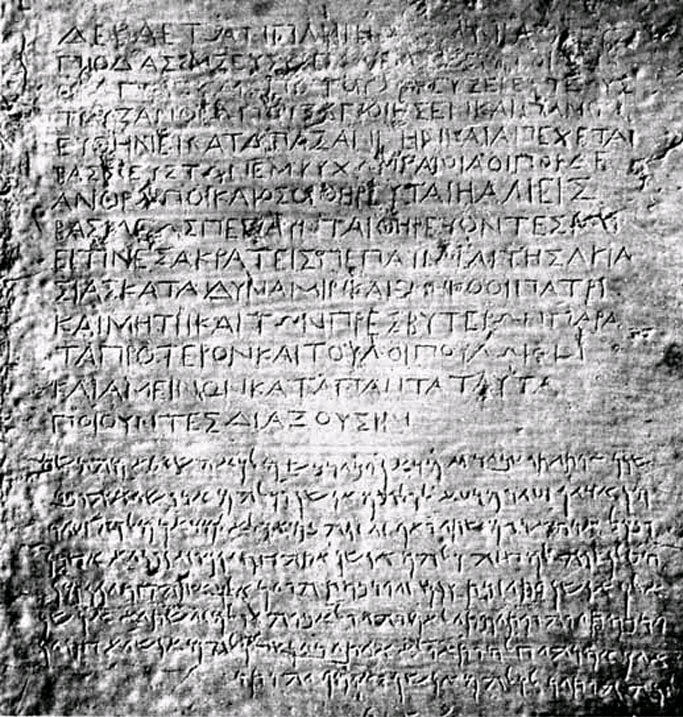
It's a bit odd that a Semitic religion ended up dominating Europe, and a blue-eyed Indo-European's religion ended up dominating East Asia - although oddly, not the land of his birth south of the Himalayas). But in the third century B.C., the Indian Buddhist King Asoka tried. After his conversion, he improved trade routes and sent missionaries throughout South Asia and the ancient Near East. In this he was like a Buddhist Constantine and Paul rolled into one; imagine a Buddhist New Testament with books named after letters to the evangelized city-states, like Alexandrians and Bactrians and Persians (instead of Romans and Galatians and Ephesians). The top image is from Wikipedia, on Buddhism and the Roman Empire. The bottom image is an evangelical Buddhist inscription in Greek and Aramaic - by Asoka, from Kandahar, Afghanistan. Contact between Buddhists and the classical Near East always seem like a bit of alternate history to us modern Westerners.


Of course some of these monuments and markers have been destroyed by our throwback friends the Taliban, but they're just doing what good fundamentalists of all stripes do: think of the Spanish missionaries destroying Mayan texts, or early European Christians censoring and smearing classical materialist works, or any number of political book-burnings in the twentieth century. This brings up an obvious question: if Buddhism had its champion in a Asoka, then where are the Buddhist temples in Athens and Afghanistan today? The answer is obvious in retrospect when you consider religion as just another set of customs. If your philosophy (whether it appeals to the supernatural or not) is not traveling along at the head of a conquering army, or the merchants and diplomats of a powerful empire, the odds are against you if you don't have another trick, like getting endorsements from people in positions of power. (Scientology had the smart idea of spreading into people who have both influence, and weak intellectual immune systems.) It also helps for your philosophy to be intolerant of syncretism and pluralism, and here Asoka was too nice. He felt bad for having prosecuted a bloody war prior to his conversion, and while he did favor Buddhism, he did not punish non-Buddhists. Buddhism eventually did reach the rest of Asia - southeast Asia in Asoka's lifetime, and then China a few centuries later - by "organic" diffusion along the silk road or from missionaries sent out by the religion itself.

Again the differing history of religion in the Far East and the Middle East/Europe is interesting. It might not be anything about the pre-existing culture or geography or political systems of the regions, but rather the coincidental content of the religions themselves. Two innovations that the three Abrahamic religions happened to produce were 1) actively excluding other belief systems and 2) early in their history, successfully infiltrating existing secular powers. Indeed the Abrahamic religions got progressively better at this as time went on. The Jews kept mostly to themselves except during military occupation, then the Christians grew to dominate Rome after a few centuries, and finally Mohammed seems to have conceived Islam as a means to political and military power right from the start. Islam - Abrahamic religion v3.0 - was the best one so far. It's also probably no coincidence that it's the cultural and geographic crossroads of the Middle East where these innovations appeared. A religion that isn't a strong competitor right out of the cradle isn't going to get very far in a place like that!

So there was no Gupta army storming west out of India to force Buddhism onto the Persians and Greeks and Romans, partly because Buddhists are not required to exclude other beliefs. Fair enough; and incidentally, some of the Mongol armies were Buddhist, and some followed an indigenous Mongolian religion, but again, neither of these required conversion. If you paid your taxes the Mongols didn't care. That's why Russians today don't follow the sky god Tengri. (The euphemism "indigenous religion" just means "a religion that's not one of the few indigenous religions that escaped the ethnic group that created them and then spread globally".) But this leaves unanswered the opposite question, which is why India and China aren't Christian or Muslim today. If Alexander had crossed the Indus - or a Chinese-Turkic empire had controlled the Middle East - then very likely whatever religions appeared in this region would have spread east at least as much as they spread west. (In a stable, united post-Alexandrian Eurasia, my money is on a prophet appearing and spreading his faith a little earlier in history.) But we should also remember that we're still in medias res of the global diffusion of ideas, and it's possible that the monotheistic, active-excluding religions just haven't had enough time to crowd out the tolerant ones with tolerant leaders. That is to say, the world's gardens haven't yet all been colonized with the most hardy invasives on offer. Of course, the parts of Asia that came into contact with Abrahamism v3.0 are, in fact, Muslim today.

In closing, modern Korea is a much more interesting case. One half of it has its own brand of exclusive Korean-nationalist communism - originally a European philosophy; how syncretic - which tolerates no (other) religion - and the other half appears very much like it's in the process of becoming Christian, complete with politically ascendant creationists trying to impose restrictions on what is taught in biology classes. And all of this in less than a century.

Tuesday, June 23, 2015

Alternate Histories: Russian Hawai'i, Swedish Delaware

Actually, it sounds like alternate history but it's not:

"In 1815-17, Kaumuali'i led secret negotiations with representatives of the Russian-American Company in an attempt to gain Russia's military support against Kamehameha; however, the negotiations folded and the Russians were forced to abandon all of their presence in Kaua'i, including Fort Elizabeth, after it was revealed that they did not have the support of Tsar Alexander I."

More here - perhaps, even stranger to my American eyes and ears than the 17th century Swedish colony in Delaware. I would think some fascinating alternative history could be written about either of these, but like all fiction, alternative history is about us, here and now, and here and now we don't think much about the Russian and Swedish forays into Hawaii and Atlantic North America (although there's online discussion of Russian Hawai'i of course, here's an online crack at a surviving New Sweden...)

I only just discovered the Points of Divergence alternate history site, which I will surely be wandering around in the coming days.

Sunday, December 15, 2013

Pancho Villa's Death: Or, Parallel Histories in Different Languages

If you're here for the alternate history part, skip to the last two paragraphs. If you want "legitimate" alternate histories, here's the most recent one.

History often seems to have gone differently, when you read accounts of the same events in different languages, especially (obviously) when the people who speak these languages are on opposite sides of the events in question. Even on Wikipedia the differences between articles are often striking. A shining example is the article about Pancho Villa, and in particular the section about his death, in Spanish and English. In particular, the less a detail supports national identity, the more likely it is to be glossed over (how many Japanese can talk in detail about Pearl Harbor; how many Americans can talk about the causal events of the War of 1812 or the Mexican War?) Do note in the English version (later) Villa's self-conscious and self-referential last words, among the best in history. But first, the Spanish version:
Álvaro Obregón became president of Mexico and when he had consolidated his position, he promoted and openly tolerated some plans to rid himself of Pancho Villa. During Huerta's rebellion that sought to prevent the imposition of General Calles, fearing that Pancho Villa again took up arms, he decided to kill Villa.

Villa was assassinated in an ambush on the afternoon of July 20, 1923 on his way to a family party in Parral. Calles asked Col. Lara to carry out the killings, and as a result, he was promoted to general and received fifty thousand dollars. No doubt American elements intervened in the elimination of Villa.

Neither did they let Pancho Villa rest at death. They beheaded his desecrated corpse and local helpers intervened with necrophilia, and the American Handal was paid five thousand dollars by the king of the American press Hearst for Villa's head, changed into a gruesome trophy.

From freedomarchives.org


Somehow the necrophilia and Hearst head-collecting are missing from the English version, which is a lot heavier on the type of mundane and sordid details that often turn out to explain much of history:
On Friday, 20 July 1923, Villa was killed while visiting Parral. Usually accompanied by his entourage of Dorados (his bodyguards) Pancho Villa frequently made trips from his ranch to Parral for banking and other errands. This day, however, Villa had gone into the town without them, taking only a few associates with him. He went to pick up a consignment of gold from the local bank with which to pay his Canutillo ranch staff. While driving back through the city in his black 1919 Dodge roadster, Villa passed by a school and a pumpkinseed vendor ran toward Villa's car and shouted "Viva Villa!" - a signal for a group of seven riflemen who then appeared in the middle of the road and fired over 40 shots into the automobile. In the fusillade of shots, nine Dumdum bullets hit Villa in the head and upper chest, killing him instantly.

One of Villa's bodyguards, Ramon Contreras, was also badly wounded but managed to kill at least one of the assassins before he escaped; he would be the only person who accompanied Villa during this assassination who survived. Two other bodyguards, Claro Huertado and Villa's main personal bodyguard Rafael Madreno, who were with him also died, as did his personal secretary Daniel Tamayo and his high-ranking Colonel Miguel Trillo, who served as his chauffeur. Villa is sometimes reported to have died saying: "Don't let it end like this. Tell them I said something." However, there is no contemporary evidence he survived his shooting even momentarily, and his biographer, Katz, confirms that Villa died instantly; Time Magazine also reported in 1951 that both Villa and his aide (Tamayo) were killed instantly. The next day, Villa's funeral was held and thousands of his grieving supporters in Parral followed his casket to his burial site while Villa's men and his closest friends remained at the hacienda in the Canitullo armed and ready for an attack by the government troops. The six surviving assassins hid out in the desert and were soon captured, but only two of them served a few months in jail, and the rest were commissioned into the military.

...

While it has never been completely proven who was responsible for the assassination, most historians attribute Villa's death to a well planned conspiracy, most likely initiated by Plutarco Elías Calles and Joaquin Amaro with at least tacit approval of the then president of Mexico, Obregon. At the time, a state legislator from Durango, Jesus Salas Barraza, whom Villa once whipped during a quarrel over a woman, claimed sole responsibility for the plot. Barraza admitted that he told his friend Gabriel Chavez, who worked as a dealer for General Motors, that he would kill Villa if he were paid 50,000 pesos. Chavez, who wasn't wealthy and didn't have 50,000 pesos on hand, then collected money from enemies of Villa and managed to collect a total of 100,000 pesos for Barraza and his other co-conspirators. Barraza also admitted that he and his co-conspirators watched Villa's daily car-rides and paid the pumpkinseed vendor at the scene of Villa's assassination to shout "Viva Villa!" either once if Villa was sitting in the front part of the car or twice if he was sitting in the back.

Despite the fact that he did not want to have a sitting politician arrested, Obregon gave into the people's demands and had Barraza arrested. Barraza was originally sentenced to 20 years in prison, The following month, however, Barraza's sentence was commuted to three months by the Governor of Chihuahua; Barraza eventually became a colonel in the Mexican Army. In a letter to the governor of Durango, Jesus Castro, Barraza agreed to be the "fall guy" and the same arrangement is mentioned in letters exchanged between Castro and Amaro. Others involved in the conspiracy were Felix Lara, the commander of federal troops in Parral, who was paid 50,000 pesos by Calles to remove his soldiers and policemen from the town on the day of the assassination, and Meliton Lozoya, the former owner of Villa's hacienda whom Villa was demanding pay back funds he had embezzled. It was Lozoya who planned the details of the assassination and found the men who carried it out. It was reported that before Barraza died of a stroke in his Mexico City home in 1951, his last words were "I'm not a murderer. I rid humanity of a monster."
Here's something you might not have known: that at the time he died, Villa had intentions of running for president of Mexico, or attaining the office by other means. Just imagine how just and peaceful a Villa administration would have been! And think also of all the people who said that with a time machine they would go back and kill Hitler (a unique take on that here). Maybe Barraza was a time traveler, but instead wiped out someone who was even worse than Hitler - that is to say, in the future Barraza came from, he wiped out someone who had been even worse, but in the future we're now living in, was eliminated. The question is, once you go back in time and successfully kill the genocidal dictator before they ever do their thing, and you survive - then what? Try to convince everyone that actually, you're from the future and this guy you murdered was going to turn out to be absolute evil? Or just keep things down to a dull roar and enjoy your life in an increasingly divergent alternate history, and maybe mention it in passing later in life? In any event I recommend we check Barraza's later bets and stock picks for uncanny accuracy.

Saturday, January 21, 2012

Colonial Megafauna: Alternative History #4

For the previous installment, check out Alternate History #3, 54'40" Was Fought.

For the next installment, check out Alternate History #5, Colonial Japan.


Among many reasons Mexican colonial history is fascinating, here are two: first, the Spanish settlement of the Americas began in earnest in the early 1500s, well over a century before the English did the same in the lands to the north. In a sense, these were medieval knights meeting Aztecs. Second, the initial Spanish explorers and colonists in Mexico found a harsher, more alien environment much closer to the coast, and much sooner. It wasn't until the mid-1800s that the now-independent English speakers to the north were trying to cross and tame the dry mountainous wastes in the interior; but try making the four hour drive from coastal Veracruz to Mexico City, and in the first hour you go from pleasant tropical coastal plains to rugged high desert. Those medieval knights were catapulted straight into the Wild West. English speaking civilization had some time to acclimatize on the somewhat Europe-like East Coast.

Alternative geography can be just as fun as alternative history. This is why the pope of alternative history Harry Turtledove has played interesting games with geography - in Down in the Bottomlands, he imagines the climate and politics of a world where not only did the Mediterranean never re-flood, but Neanderthal nations exist alongside those of Homo sapiens. In Opening Atlantis he imagines the East Coast of North America as if it had broken away from the rest of the continent, like North America's Japan or New Zealand; it would be closer to Europe and therefore discovered earlier.


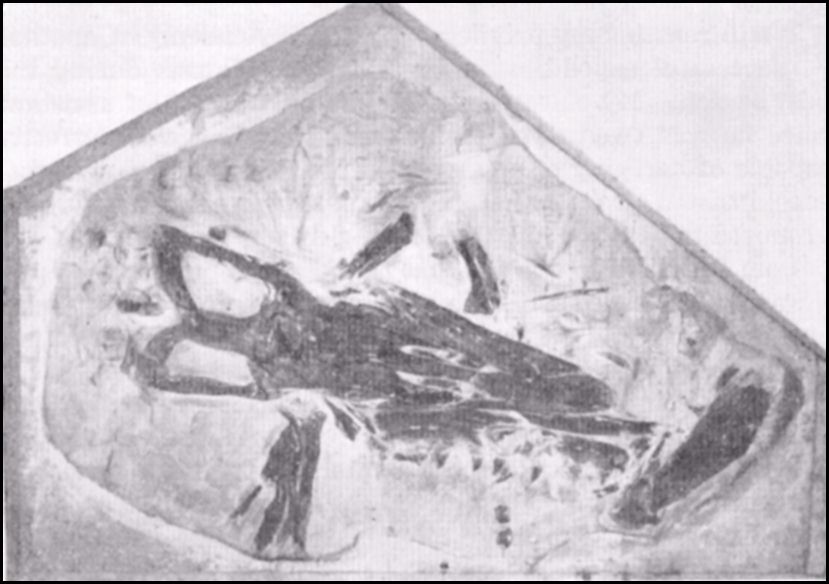
A tylosaur skull found in the early twentieth century in Kansas. Tylosaurs were open-ocean predators.


At one time there was in fact a sea coast along what is now the western U.S. - the Western Interior Seaway during the creataceous. (This is different from what Turtledove imagined, which was essentially an East Coast broken off at the Appalachians and moved east.) The cretaceous seaway is why we find marine fossils in Kansas and Montana. Of course at that point there were no people to colonize North America yet. In fact there may not even have been any primates yet.


Imagine that not only the geography of that western continent stayed the same to the present day, but that there was no eastern continent at all. The experience of English speakers would have been more similar to the Spaniards, encountering high mountains and deserts and alien environments a day's ride from the coast. Agricultural land would have been more valuable; on the Western continent there couldn't have been the same real estate crash that happened shortly after the Revolution, during our expansion over the Appalachians, that drove Thomas Jefferson into relative poverty. The coasts that turned into ports and market places would have been more valuable as plantations, as remained the case in Virginia and the Carolinas (where the mountains were indeed higher) and of course in Veracruz. From north to south, Missoula, Idaho Falls, Salt Lake City, and Gallup would have been port cities with their backs immediately to the Rockies. (Note too that in the real world, this was almost all Spanish territory first.) They would have been greener and less continental in their climates, but the interior encountered by John Smith would have been a place of mountains and deserts unlike anything he'd seen in Europe. The settlers of Jamestown would've had to become King James's first cowboys.


What If Europeans Really Did Discover America?

There's another surprise in store for the pseudo-cretaceous John Smith: in this world, Europeans really are discovering the Americas. There was no land bridge; the Europeans are really the first ones there. Excellent! No need to steal anyone's land or oppress native cultures! Good news, right? Wrong.

About the time that the first Native Americans were colonizing the interior of North America, 10,000 years ago, there was a megafauna extinction. We're not yet certain that it was the paleolithic Native Americans who did it, but that's the best guess so far: humans are pretty good at disrupting ecosystems, through some combination of hunting to extinction, altering landscapes with fire, and maybe even bringing a few non-native organisms with them. My bet is that it was indeed the paleo-North Americans that did it. (Note to paleo-North Americans: Thanks. The Western U.S. is still scary enough with mountain lions.)

And that's lucky for the real John Smith, and non-Native Americans: not so lucky for when pseudo-cretaceous John Smith goes up into the mountains that begin twenty miles from the port of Gallup, because it's going to be a regular Land of the Lost up there. He's going to meet mammoths, and sabretooth tigers, and dire wolves. Sabretooths are bad enough, but dire wolves move in packs and weigh about 150 lbs. (If you're in Los Angeles check them out at the tar pits.) Sure there will be tortoises and sloths for him to eat when he's out in the bush, assuming he remains at the top of the food chain. I'm imagining a battle during the pseudo-cretaceous American Revolution, when the British regulars are charging the American lines, only to have the battle end in a panic when a herd of mammoths emerges from the Rocky Mountain forest, scared by the cannon, charging the field and scattering the soldiers of both sides. Or maybe Cortez's party turned back to the coast when a pack of dire wolves comes out of the brush near Texcala, not slowed by their primitive guns, and kills dozens of men in full armor and sends the rest running back to the coast wetting their pantaloons in terror, cursing their leader for burning their ship and trapping them in this hellish land.


Hey Lewis and Clark: how far do you seriously think you'll get in this place? By yourselves, with no native guides? The only other continent with comparable megafauna to this is Africa, and it's right next to Europe, and in the middle of the nineteenth century Europeans were still exploring the interior.


There have been alternative history/borderline fantasy books written imagining an America with dinosaurs still running around - in particular, Kurt Giambastiani's The Year the Cloud Fell, which features Custer's much more evenly matched war against the Cheyenne Alliance, interrupted by T. rex attacks (In this world's Dakotas, Sue is still alive and well.) The dinosaurs in the American West with Native Americans meme is over a century old so I'll send you here for more.

It's hard to say how different a pseudo-cretaceous North America would look and how it would effect the world. Assuming initial Spanish settlement, it's possible that Spain would have dominated the entire New World, without allowing any of the other powers to get a foothold. The land would have been more mountainous and drier on average and much less productive; and the dangerous wildlife would have dramatically slowed development of the interior. Without a native population to enslave, the riches that Spain extracted from the New World would have been much slower to come. This may have meant a faster decline of Spain, and a quicker rise and larger relative role in European history for the Netherlands, whose trade empire was only partly dependent on the Americas. The Netherlands may have ended up playing a role in the Age of Discovery in the rest of the world more similar to Britain. Home rule of the Americas would have been much slower in coming.

Sunday, December 21, 2025

The Mongols Were Good For Europe

For the most recent alternate history thought experiment, see Ancient East Indian Settlement of Australia. For the next one, see What if Christianity and Islam Co-Existed with Classical Philosophy Communities, like Epicureans and Stoics?

As a standard refrain: it's depressing that almost all alternate history is about some episode of organized violence ending differently. It would be much better to instead focus on counterfactuals about the spread of technological and cultural innovations. What would a Tang or Byzantine industrial revolution look like? What about North America where they never forgot about ironworking around the pre-Columbian Great Lakes? But the next best thing would be to take a war or conquest out of history altogether.

So what if, instead of gory scenes of Asian steppe horseman dragging the Pope to the Tiber, wrapped in a carpet, we take the Mongols out of history completely? First, it's always worth pointing out: both China and Russia were ruled by the Mongols, the last nomadic conquerors, for the better part of two centuries, and they're both still here, though obviously different for it. Baghdad, the heart of Islam, was sacked horrifically, and that religion is hardly obscure today.

It's counterintuitive to talk about the benefits of the Mongol conquests, but they arguably created an advantage to Europe and contemporary Christendom. Best understood, after the Mongol conquest, the Silk Road was safer, facilitating diffusion of goods and technological innovation that frequently originated in the Middle East and China; at the same time, those competitors were weakened and development slowed by the conquest. It's not implausible that the dynasty that followed the Song would have been more advanced than the Yuan, and less inward-focused, as the Ming was in our history. The treasure fleets would likely have started sailing earlier, and Europe (with less technology and less experience with trade) later. A fifteenth century industrial revolution in China is not an absurd notion. At the same time, the cities and states of Central Asia would have continued flourishing, and Islam would not have had the violent psychological collapse and loss of its cultural center of gravity that the sack of Baghdad effected.

In Europe, we might see multiple states in what is now Russia and Ukraine around Kiev, Pskov, Novgord, and Moscow, though if there was consolidation to a single state, more likely it would have been Kiev than Moscow, without the Mongols appointing the Muscovites as their tax collectors. More importantly though - in our history, Constantinople was explicitly an ally of the Mongols, although in the end, the Mongols cursed Constantinople to fall sooner - by creating a power vacuum in Anatolia that was not truly filled until the Ottomans appeared. Without the Mongols creating anarchy, Constantinople would have survived longer. This would actually have been bad for Europe. When Constantinople fell, the Ottomans then controlled the Silk Road and cut off Silk Road trade - which thanks to the Mongols, European merchants had been using to their benefit. It was in the decades following the fall of Constantinople that European merchants sought ways to replace this route, and they were so desperate that they started doing things like sailing around Africa, or even hail-Mary voyages around the back of the Earth so they could (in theory) approach China from the ocean to its east. Finally, in our history, cannons became important by the mid-1300s in both Europe and China. With the uninterrupted development of China's economy (and a possible early industrial revolution), and a slowed diffusion of technology back to Europe from a more dangerous Silk Road, they would have developed cannons earlier than Europe. An Asian great divergence, in terms of both technology and colonization of the New World, becomes much more likely.

You could argue that it was the geography of Europe that predisposed it to diverge from China in the early modern age, and I think that is true as well; but even so, Europe was only ahead of Asia by one or two centuries. That's why, by smashing most of Asia but turning around at Hungary and Poland, the Mongols did a great favor for future Europe.

Monday, August 29, 2011

Not an Alternate History Map


That's China's actual territorial waters claim. From this article. Much better and more thorough analysis of Chinese naval ambitions here.

(For actual alternate history go here.)

Friday, January 3, 2014

If Every U.S. State That Tried to Secede From Another State Became a State

It would look like this. I'm now living in Reagan (I might actually be if the current petition to divide California succeeds). As for the place of my birth, it didn't change names although the lower three counties succeeded in seceding and are now called Delaware. Jerks. (Full on alternate history here; cool alternate geography here, here or here.)

Sunday, March 20, 2016

Europe as China: Why Didn't It Happen This Way?

Exposition from a real-world standpoint here. If you enjoy the alternate history aspect of this piece you should see What Do The Patterns in Alternate Histories Say About Us?, which also links to other thought experiments.

Added later: Razib Khan rounds up findings, arguing that China's uniqueness comes in large part from strong cultural continuity, i.e. no historical amnesia, similar to the central conceit of this post - China had no Bronze Age Collapse, and no antiquity-to-medieval collapse. The biological analog is to imagine the overgrown trilobites and insects of a continent that was somehow spared the Permian-Triassic extinction and the K/T boundary.

Look at a satellite image of Daria and eastern Eurasia. In some ways they seem quite similar: green, fertile places with large population centers. There the similarities end. One is a jumble of small competing states, the other an ancient kingdom. Why did things turn out so differently?


Daria was not always a single unified state so it is useful to review the first dynasty which controlled much of its modern territory. Prior to the Persian Dynasty, there was no Daria as such, but really just southwestern Eurasia, a collection of small city-states trying to hold on to the territories around them and constantly fighting; hence this is referred to as the Warring City-States Period (a term invented by a Darian historian during the Caesarean dynasty). Stretching back into the West Eurasian bronze age there are names of dynasties (the Hittite and Sargon) which I will neglect here because it is difficult to separate legend from fact. In any event it was not until the Persian king took Athens after the Battle of Salamis that a large portion of what we now know as Daria was unified. The officers of the Persian Dynasty wrote that the people living in Athens ("Greeks") were unique-looking, often with blue eyes and sometimes light hair, who worshiped a large contingent of gods headed by a triumvirate, instead of the Zoroastrian dyad that we all know today. Consequently we can infer that the people of Greece province, and probably Italia and Hispania, were culturally and ethnically distinct from the unifying Persians. (And here is our first question: why did the super-state of Daria unify so early to be ruled by one dynasty after another, with only brief periods of fracture, in contrast to East Asia - to the collection of belligerent states known collectively as "China" - which has only been half-ruled by one state and only for a few centuries at that?)

The armies of the Persian king (later emperor of Daria) then went on to conquer Macedon, stopping their northward advance in the wild forests of the Southern Balkans, as well as taking the Italian Peninsula and Spain - which again at the time were not Persian lands, but had people living there called "Punes" and "Romans". These people were also gradually absorbed by interbreeding with the soldiers and administrators who came to settle the conquered lands and by multiple waves of immigration from further east with the future dynasties, giving rise to the large ethnic majority who later spread north from Mediterranean Daria, calling themselves "Caesareans". Caesareans do not make up all of Daria, and today there are autonomous regions (often politically troublesome) set aside for Russians and Turks. Even in the Caesarean areas, travelers remark that there are still minorities with distinctive dress, ceremonies and cuisines in mountain areas that the Darians never fully absorbed, like the Huns and the Basques, but the reach of the modern government (and tourists) may be finally eroding these distinctions. Xerxes noted that the people of the unified continent had rich and chaotic modes of thought, some of which were debated in public, and multiple schools existed without state sanction, especially in Athens and Jerusalem. Consequently, the Persian king ordered the Purge of Philosophers. Some philosophies survived, like the Stoics, mingled with the syncretic and polytheistic belief systems that so bewilder us Easterners, but others like the Pythagoreans or Judaism are known only from history.

After infighting back in Babylon, the Persian Dynasty fractured in a mere decade, leaving general Mardonius in charge of Western Eurasia. Daria was finally reunified two centuries later when Alexander founded the Macedonian Dynasty, extending Daria past the Balkans and Alps to the Baltic; the Caesarean, Ostrogoth, Frankish, and Habsburg dynasties followed the Macedonian. Aside from a few fractures between geographically remote parts of Daria, most of the kingdom, from the Baltic to the Mediterranean and the Indus to the Atlantic, has remained one nation ruled by the Caesareans to this day, although a different dynasty has come into power every 200-250 years, with the capital moving between Athens, Rome, Baghdad, and finally where it is today in Amsterdam. The Hindu scholar Brahmagupta noted that the new dynasties tended to come from the fringes of Daria, after the current dynasty had begun to ignore the world outside its borders and even outside the intrigues of its courts. The clearest such example was the Norse Dynasty, when the legendary men of the sea swept out of Scandinavia and up all the rivers of Europe, absorbing the peoples of conquered provinces until the gutters of Athens ran red with blood. (This is the reason for the famous inscription near the Matterhorn where the young Emperor and his advisor, last of the Justinian Dynasty, leapt to their deaths to avoid the ravages of the Northmen.) Despite two efforts, the Northmen were somehow never able to conquer the Maghreb, as their naval expertise did not apply in the desert. The Northmen famously conquered even India and the eastern regions of Russia, and there is a cottage industry of shuddering with horror at the thought of them sailing up the Irrawaddy and the Pearl and the Yangtze. And indeed, there is every reason to think that they would have wiped out the kingdoms of Qin and Chu and Jin, as in their one encounter, they made short work of the best forces East Asia had to offer at the time, the combined navies of Qi and Lu and Wu fighting side by side in the Hainan Sea. But in both cases, they turned around. Coincidence matters; both times when they were preparing to take the whole Pacific Coast, the death of the their high leader the Konungur called them back for an "Al-thing", a council discussion of succession. (Of course, some historians contend that their animals and war techniques and northern constitutions would not have done well in the damp summer heat of the coast.) When Mikl Konungur (which just means the Great Konungur in Norse) died, their great empire split into four pieces as fast as they had conquered it, with Olaf Konungur holding onto the prize of Daria.

And of course, any mention of the Northmen and in particular Olaf Konungur is the natural jumping off point for the history of the East's contact with Daria. East Asia had a very different history leading up to that point. While then Qin famously made several bids on the southern coast of East Asia, they failed; and of course the king of Shu created an empire, but coastal East Asia had little to offer in those days, so he went toward the places of culture and learning, the birthplace of the Buddha, going around the Himalayas to India, only stopping his advance at the Indus River when his men revolted and refused to march further west. And following this, the Han Empire whose legacy most shaped East Asia unified the coast for several centuries. Many books have been written on the rise and fall of the Han Empire (the classic being that by Nakayama) and many leaders have claimed to be building a new Han Empire (among them Yan Li, Chao Po, and of course generations of insufferable Japanese officials after visiting the ruins of the Han baths in Tohoku, just to name a few). But the fall of Han Empire certainly resulted from some combination of poor succession processes, complacence about the outside world, and increasing incursions by the Xiongnu and Turks who the Han increasingly relied on to fill the ranks of their armies. A much debated point is the role of the spread of Neo-Shiva-ism in the empire's decay, ever since Xao Ti's very public conversion and dividing the Han Empire into halves, with capitals at Xi'an and Shanghai. Of course the Xiongnu hordes took Shanghai one last time, and the Mongols took Xi'an, and after that East Asia was back to its natural state of multiple competing states: Shu, Jin, Han, Korea, Vietnam, Shaanxi, and all the rest. (As an aside: it is hard to square the two images we have in the East of the steppe people: the rampaging Mongols and Manchus, who seemed to suddenly settle down into well-run welfare states to make pop music and home-assembled bamboo furniture for the rest of us.)

It was from this fractured world, living in the shadow of the fallen Han (as we still do today) that Tu Pei traveled along the Silk Road as a merchant to visit the famed riches of Daria, at the time of Olaf Konungur's rule, just after the Northmen had conquered the ancient land. Kawashima Mirai's poem about Olaf's stately pleasure domes of Hamburg strike us as a bit over-romantic and even racist today, but this gives us an idea of the fantastic riches Tu Pei thought he might find. As Tu learned, our term Daria is actually the name that the Persian king Xerxes gave to his unified empire in celebration of his victory, naming it after his father, but ironically it derives from a state the only lasted a decade - which happens to be when Han traders started writing about it. Their literal term for themselves is the somewhat arrogant-sounding Ohrmazd-Land, or the Land of the God of Light. East Asian merchants (especially Shanghainese like Tu) were at the time frequent traders, but they knew only marginally more about the Occident than the man in the street. That they knew anything at all was partly a result of the Lingades, the series of bloody wars that resulted from East Asian Neo-Shivans taking back India, the land of their prophet's birth, from Buddhists; though disastrous, this revitalized the Silk Road re-established a middle class in the East Asian states that had not truly existed since the fall of the Han Empire. (This is the second question: why did religion in the East evolve such that it was synonymous with political power? Why is religion in the despotic West syncretic and tolerant of other traditions?) Scholars doubt how much of Tu's story can be taken at face value, but he accurately described many of the Darian landmarks he claimed to have visited, the Acropolis and Coliseum among them (it is a widely believed misconception that he saw the Great Seawall along the Baltic but this was not built until the Habsburg Dynasty, partly as a reaction to the invasion of the Northmen). Tu claimed to have been given a position in the local government of exotic Germany province (Tu had never seen snow or drunk beer) which seems strange unless we remember that the Northmen were warned by Darian advisors that the conquerors of Daria often found themselves absorbed, so they were in the habit of trying to avoid this by appointing foreigners. (In fact they even switched their administration's records from those based on the Phoenician script to one based on Irish Ogham runes, given the strange Norse affinity for the Celts through their brand of Neo-Zoroastrianism; but this did not spread beyond the Norse Courts.)

As we know, the Habsburgs replaced the Norse Dynasty, and indeed the gradual failure of the remaining Norse satrapies seemed to signal a decline not just of Daria but of West Eurasian in general in world affairs starting at that point in history. The Red Sea-Horde held on in India for a century longer (Eastern scholars have often wondered why India retains a tradition of despotism into the modern age when democracy has flourished in the rest of Eastern Eurasia). Even into the age of discovery, relations between East Asia and Daria largely remained those of trade. And the third outstanding question is why the technology and wealth of the East Asian states progressed rapidly beyond that of Daria during this era; the trends were underway well before Japan and Guangzhou began exploiting their colonial possessions. and while Japan, Korea and Guangzhou were colonizing the Two Eastern Continents, they certainly had designs on Daria but outright conquest of such a large and unified state, from a distance no less, was clearly impossible.

As East Asia began colonizing the planet in earnest, the Habsburg Dynasty fell and was replaced by the Finnish (although one Habsburg general did hold out on Mallorca for years). Much has been made of the complacency of the Darian emperor in rejecting the gifts of the Japanese merchant Ishizaki: "What could Japan have that Daria could possibly need?" Meanwhile, control of the islands of the Mediterranean was effectively ceded to one or another East Asian power. Very few West Eurasian states held out: Cromwells who controlled the British crown perhaps wisely remained closed, allowing the Koreans their trade base on the Island of Wight. (It is underappreciated that with help from Guangzhou, the British briefly built their own ships, crossing the Atlantic to trade with Mexico before the Cromwells declared the policy of isolation.) The independence of most of the East Asian colonies changed life very little in Daria, which became progressively more miserable under the Finns, with famine after famine and cession after cession. The East Asian nations began to cooperate to carve up spheres of influence. In most of East Asia, the civil war in the Japanese-speaking United States of Yuanshi was better known than the Napoleonic rebellion in Daria, led by a newly-converted Zoroastrian which resulted in many million more deaths and a near-miss for the fall of the Finns. In the end, it was the curious combination of neo-Han and Buddhist ideals that led to the establishment of the US of Y, and progressive constitutional freedoms in East Asian states, that spread to Daria. A graduate of an eastern-style medical school named Hans Reber took it upon himself to spread these ideas, so it was ironic that when the Finns finally fell, he was in Asia. The ideas of freedom did not take root easily, and the next several decades were filled with famine and unrest, opening Daria to a brutal occupation by British forces. The men serving competing ideals of how to structure the new republic held an uneasy truce while fighting the British. Of course the British withdrew after Yuanshian forces dropped atomic bombs on Manchester and Cornwall, and within a few years the Long March by Kovacs drove Dubois out to Mallorca, which remains de facto independent but claimed by the People's Republic of Daria.

What now? The Shaanxi general Yan Li famously said, "Daria is a sleeping bear, and we would do best not to wake it." It is now awake. After a disastrous first few decades, it has relaxed its policies and grown rapidly, surpassing the U.S.Y. as the world's biggest economy. The surrounding nations of West Eurasia like Ireland and Scandinavia have become quite nervous about the ambitions of Daria and have been driven somewhat into the orbit of the U.S.Y. and strenghtened military and economic ties with ANWEN (the Association of Northwest European Nations). Darian human rights are still an issue, although the Darian government points out the U.S.Y.'s and other Eastern countries' less than perfect record in this regard; candid moments with Darian officials and citizens also show a willingness to tolerate some oppression for the sake of growth, although of course the enlightened citizens of the East would argue that this tradeoff is unnecessary. The East's and in particular the U.S.Y.'s relationship to the wakened bear teeters between that of enemy and friendly competitor. But if Daria and the East want to remain isolated, that ship has already sailed. Eastern universities are filled with Darian students, some of whom remain and of some of whom return home with Eastern ideas. There are Darian restaurants in every city in the U.S.Y., which most Yuanshians would be loathe to give up out of misguided patriotism (even if they don't all know how to correctly use a spoon and knife to eat). But it appears Daria's growth is stalling, making its people again wonder whether this dynasty too has lost the mandate of heaven. The world has become a small place, and history is not over.


Mahesh Nekotani
O-shu, Gosaihama, United States of Yuanshi
Mind-integration physician, University of Gosaihama at Iwatani